How to Use Slate and Marble Powders for a Retro Resin Vase
Have you ever wanted to try something completely new with your resin projects? Most crafters stick to standard liquid pigments or mica powders, but combining different types of materials can create absolutely stunning, unpredictable patterns.
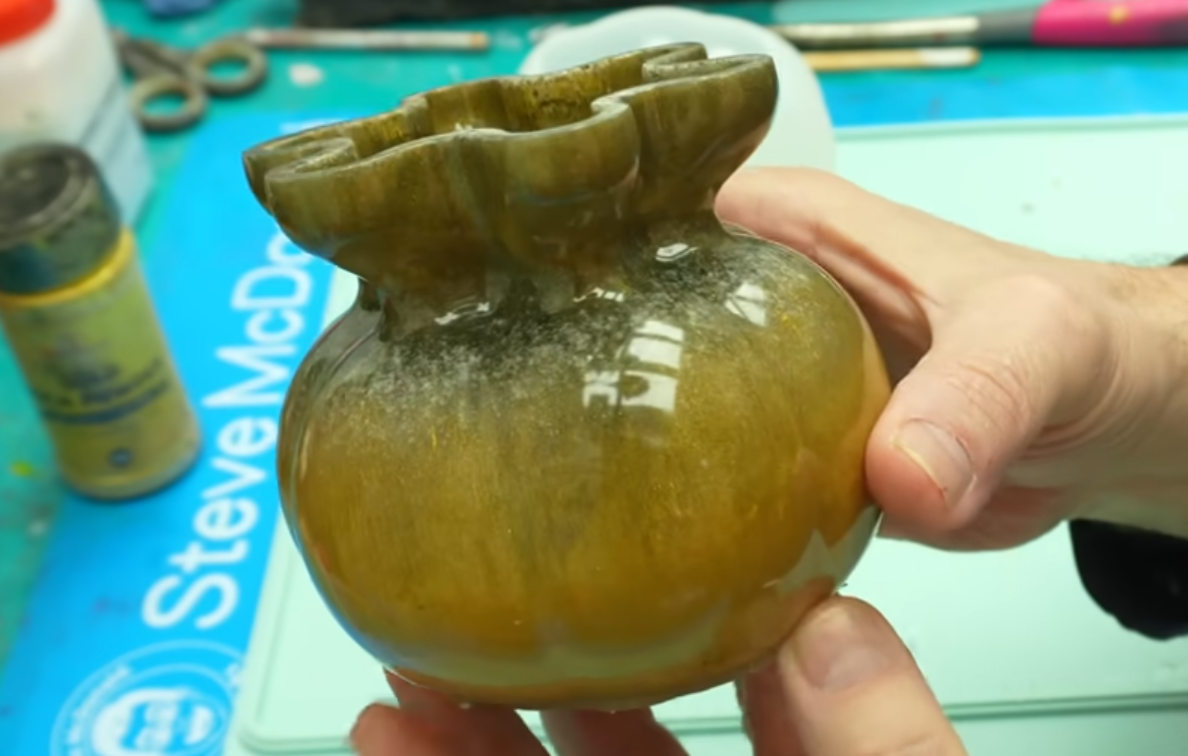
In this guide, you will learn how to mix heavy rock powders, specifically slate and marble powder, with gold mica powder to create a beautiful, retro-style vase. This technique relies on the different weights of the powders to naturally separate and sink inside the mould, leaving you with a gorgeous gradient and streak effect reminiscent of 1960s and 1970s design.
The "Dirty Pour" Powder Technique
This project uses a method called a "dirty pour". Instead of pouring different coloured resins into the mould one by one, you layer the colours into a single pouring jug first. Because marble and slate powders are much heavier than mica powder, they sink through the gold resin at different speeds. This creates natural movement and unique streaks that you simply cannot get with standard colouring methods.
Steps
Before you begin, make sure you are working in a well-ventilated space and have your safety mask ready for handling the raw powders.
1 Measure the mould capacity: Prerequisite Step.
If your mould does not state its volume, fill it with water first. Pour that water into a measuring jug to find the exact amount of resin you need. For a standard small vase mould, this is usually around 460 ml.
2 Dry the mould completely: Critical Safety Step.
Dry the silicone mould thoroughly after measuring. Even a tiny drop of residual water left inside can completely ruin your resin and prevent it from curing properly.
3 Warm the resin parts: 10 Minutes.
Measure out equal parts of your A and B resin (for example, 200 ml of each for a 400 ml mix). Seal the mixing cups with lids to prevent condensation from dripping inside, and place them into a resin warmer or warm water bath for 10 minutes. Aim for a temperature slightly above room temperature, between 30°C and 35°C, to ensure a bubble-free consistency.
4 Mix the resin: 4 Minutes.
Dry the outside of your containers thoroughly before opening. Pour Part A and Part B together into your mixing pot. Mix the liquid thoroughly for 4 minutes using a hand mixer or an automated mixer with silicone paddles.
5 Divide and add the powders: Colouring Step.
Divide your mixed resin into separate cups. Use less resin for the gold mica, as it should act as an accent colour rather than dominating the piece. Put on your safety mask and mix the slate powder into one cup, the marble powder into another, and the gold mica into the smaller portion. Mix thoroughly.
6 Let the bubbles pop: 5 Minutes.
Mixing heavy rock powders traps a lot of air. Let the coloured cups sit for 5 minutes so the bubbles can rise to the surface. Use a small kitchen torch to gently burst the layer of bubbles off the top of each cup.
7 Layer the dirty pour cup: The Creating Step.
Take a fresh pouring jug and begin layering your colours. Start by pouring in some slate resin, followed by a layer of gold, and then the marble resin. Repeat this sequence until your cup is full. The heavier slate and marble will immediately begin to sink through the lighter gold layer.
8 Pour into the mould: Slow Pour.
Slowly pour the layered mixture into your dry vase mould. You will immediately see the colours moving and shifting. Some tiny solid lumps of slate and marble powder may remain, which adds to the natural stone texture.
9 De-mould the vase: After Full Cure.
Squeeze and tap the sides of the mould to help any trapped air rise to the top, popping bubbles with your torch as they appear. Leave the resin to cure completely. Once hardened, gently peel away the silicone mould to reveal your finished vase.
Tips
Never use cold resin: Cold resin is thick, cures cloudy, and traps thousands of tiny micro-bubbles. Always warm your components before mixing to achieve a crystal-clear finish.
Keep water away from open resin: When heating your cups in a water bath, always use tight-fitting caps or lids. Water evaporation can create condensation that drips into the mixture, which spoils the chemical cure.
Clean silicone paddles immediately: If you use an automated mixer, clean the silicone paddles right away with a wet wipe. Do not let the resin cure on the paddles, as cleaning them later shortens their lifespan.
Wear a mask: Raw slate and marble powders are incredibly fine. Always wear a protective dust mask when scooping and mixing them so you do not breathe in the particles.
FAQs
Why use slate and marble powders instead of normal pigments?
Liquid pigments and mica powders are very lightweight and blend together easily to form solid blocks of colour or smooth ombre effects. Slate and marble powders are actual crushed rock, meaning they are much heavier. This weight causes them to sink through the other resins, creating unique, organic streaks and a layered, retro appearance that lighter pigments cannot replicate.
What should I do if my mould doesn't have a flat bottom?
Some vase moulds have an internal design that sits a bit too high, resulting in a very thin base for your finished vase. To ensure your vase is stable, make sure to fill the mould completely to the top rim to give the base as much thickness as possible.
How do I prevent the heavy powders from turning into a big brown mess?
The trick is the layering sequence in your pouring cup. By keeping the gold mica between the dark slate and the white marble, the heavy powders have to travel through the gold accent color as they sink. This prevents them from simply mixing together into a dull, solid colour.
Tools and Materials
📌As an Amazon Associate, I earn from qualifying purchases:
(USA) Here is my amazon store for the USA
(UK) Here is my Amazon Store for the UK
Individual links below for the items used in this video:
LINKS FOR USA ONLY
(USA) Resin: https://amzn.to/4t4QEny
(USA) Vase Mould: https://amzn.to/4szgSP8
(USA) Slate Powder: https://amzn.to/47qMVID
(USA) Marble Powder: https://amzn.to/4bPdt7I
(USA) Mica Powder: https://amzn.to/3NsvzEF
(USA) Resin Warmer: https://resiners.com/?ref=r1ere84v
(USA) Resin Warmer Amazon Link: https://amzn.to/40WfZnF
(USA) Resin Mixer: https://resiners.com/?ref=r1ere84v
(USA) Resin Mixer Amazon Link: https://amzn.to/4uUpod5
(USA) Large Cups: https://amzn.to/4c67sop
(USA) Silicone Lids for Cups: https://amzn.to/4rYJY9w
LINKS FOR UK ONLY
(UK) Resin: https://amzn.to/4rWJpgq
(UK) Vase Mould: https://amzn.to/4sA2tCf
(UK) Slate Powder: https://amzn.to/4uUMOz1
(UK) Marble Powder: https://amzn.to/3PpHQdB
(UK) Mica Powder: https://amzn.to/4bPMdGn
(UK) Resin Warmer: https://resiners.com/?ref=r1ere84v
(UK) Resin Warmer Amazon Link: https://amzn.to/3PzANin
(UK) Resin Mixer: https://resiners.com/?ref=r1ere84v
(UK) Resin Mixer Amazon Link: https://amzn.to/4uY0LfS
(UK) Large Cups: https://amzn.to/4c3TUdb
(UK) Silicone Lids for cups: https://amzn.to/4vdiKiz